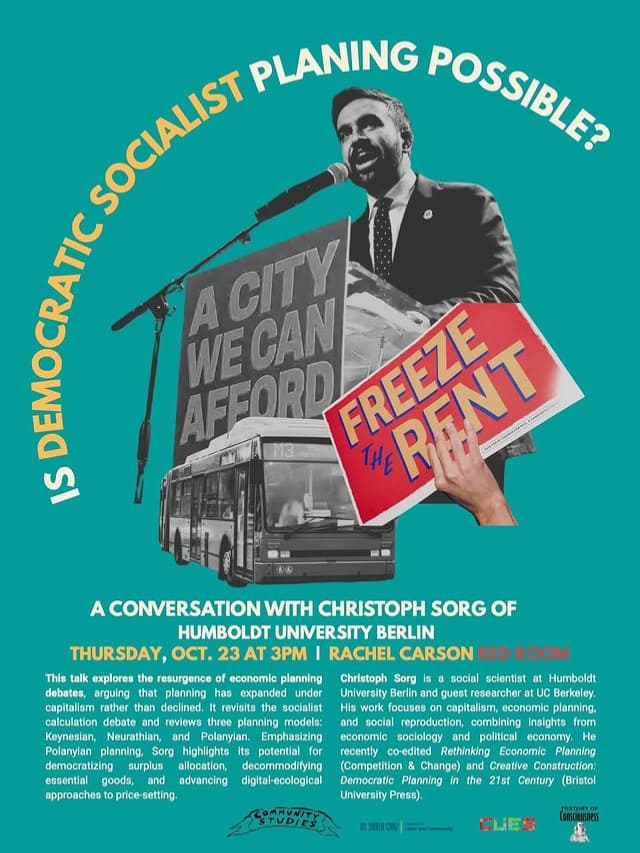
So I just came across this event poster on Mike McCarthy’s instagram. As soon as we have more info on it and the link, etc. we are gonna share it.
What I wanna talk about, is that this is one of the few times that I’ve seen any kind of aesthetic (event poster, book/magazine/article cover, etc.) in the context of DEP that made me go “oh, interesting”. I think here it’s the connection with Mandani (whatever you might think of him) and the imagery and associations around his campaign + the rephrasing from “democratic economic planning” to “democratic socialist planning”, connecting with the already familiar phrasing and identifications around that term + the overall aesthetic of the poster resembling the aesthetic style that we’ve seen coming from campaigns left on the US political spectrum. All of these immediately bring DEP closer to actual political movements, campaigns, stakes, and away from the academically confined spaces it too often finds itself in - at least in the perception of the event, thereby influencing who will attend, how the event will be perceived and ultimately what impact it will have. You might evaluate that or certain parts of this in a more negative or more positive way (e.g. the association with Mamdani as a political figure - dependencies this could create, etc.), but I think the power and influence of aesthetics in shaping the factors I just mentioned (perception, associations, headspace it primes people towards, who will attend, impact) should be plausible enough. This is why we need to take aesthetics seriously as a strategic matter (think about it a bit like advertising), even if you have no inherent interest in it whatsoever. And let’s be real, in academic circles interest in aesthetics is mostly looked down upon or regarded as secondary (even though academics are attached to academic aesthetics like glue).
I agree and I think your recent talk raised a lot of good points. Aesthetics are carriers of meaning and values. You mentioned specifically that planning aesthetics have a couple of draw-points, which includes various Soviet imagery (both avant-garde and the realism), the high-modernism or utopian aesthetic (computers and green-dome living spaces and the like), or nostalgic imagery (like those around Cybersyn).
The fact that Mamdani replaces economic with socialist perhaps allows him to use a word (socialism) that in a broadly defined US left scene now signifies the growing counter-current. And using ‘socialist’ perhaps also can allow him to use imagery of the 70’s social movements which also were opening up to that, and which have a similar subaltern and subversive element. So nostalgic images can also be conjured up to project into the future. Like for example musicians like Steve Earle or Daniel Kahn have channeled images of Woody Guthrie and Joe Hill, but translated them into relevant contemporary art. There’s a rich tradition to draw from for potential imagery that could carry meaning of planning, coordination and cooperation in its various forms. Just off the top of my head:
- from late 19th century art-nouveau and symbolism that was used in ‘First of May’ pamflets and posters,
- to surrealism and naïve art of Rivera, Kahlo, etc of the early 20th,
- to mid 20th century avant-garde of CoBrA (Appel and Constant),
- and constructivism of Gerd Arntz (isotypes and infographics), or graphic work of Frans Masereel
I think cultivating this historical legacy and finding elements that resonate with people involved in economic planning is not only a cool and fun thing for our community, but connecting this to what real movements will use to mobilize, to convey and interest audiences in values and meanings will help us converge on our goals.