Hi everyone,
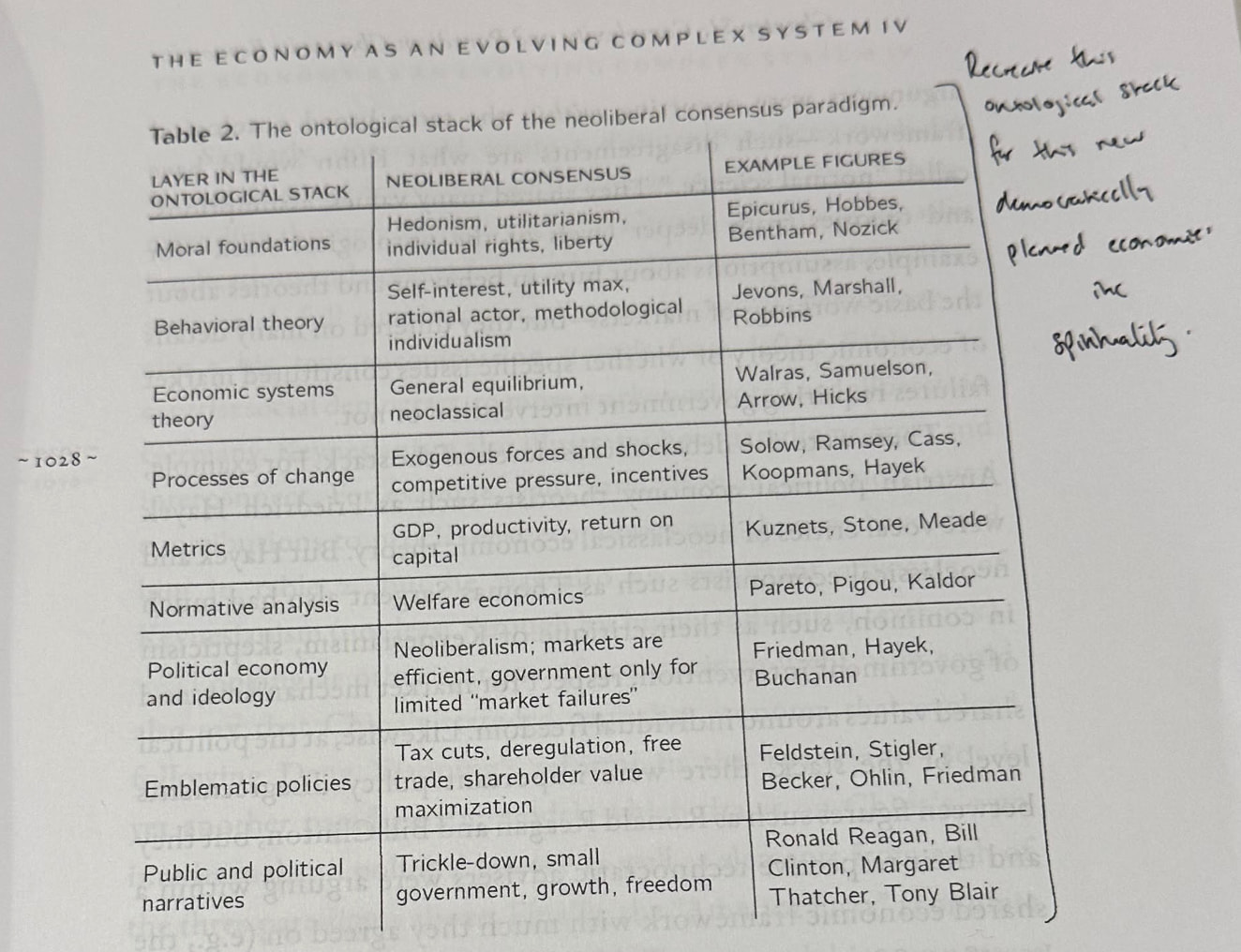
I’m writing a research paper on alternative economic futures, there’s a primary data element where I intend to engage with religious and spiritual groups to inform some of the quantitative and wider literature aspects. I’d love to know your thoughts on what the “ontological stack” for democratic planning would be i.e what the “set of mutually reinforcing, interlocking concepts that form the basis of an economic paradigm”. For example the ontological stack for neoliberal economies can be defined as:
Let me know your thoughts, thank you.
1 Like
Hey Ikra!
Kind of a rough sketch but,
Layer 1 — Ontological foundations: Epicurus, Lucretius → Marx’s materialism (the Theses on Feuerbach explicitly bridges Epicurus to social ontology)
Layer 2 — Epistemology & measurement: Neurath/Vienna Circle, but also Stafford Beer (cybernetics as the engineering complement to Neurath’s philosophy — how do you actually process social information at scale?) Norbert Weiner, and John von Neumann could probably also fit in here.
- Could possibly also include people like Claude Shannon and Nicholas Georgescu-Roegen for information/entropy somewhere.
Layer 3 — Critique of capital: Sraffa + Kalecki together as the double critique — Sraffa demolishes the neoclassical theory of distribution, Kalecki provides a macro framework where investment and class power are central. Both are prerequisites for thinking about planning seriously.
Layer 4 — The calculation debate: Lange/Lerner/Taylor, but also Mises and Hayek on the other side (yuck).
Layer 5 — Computational synthesis: Cockshott & Cottrell, Farjoun & Machover, Beer’s Cybersyn. Also von Neumann and Qian Xuesen.